Major platform update
A new Festivo.Same holiday API — vastly more around it.
Over the last cycles we shipped a full-stack expansion: governed holiday calendars, HiBob HR sync, public pages & embeddable widgets, business-time APIs with a lab UI, a rebuilt customer portal across every major route, billing & enterprise auth depth, webhooks & integrations, and delivery safeguards for email reputation.
Your Public Holidays API contract stays the continuity story. What changed is the control plane and the surfaces teams use to design, publish, share, and operate on top of that data.
The release in depth
What we actually shipped — not a minimalist bullet list.
Each chapter follows a real part of the Festivo workspace—calendars, HR sync, public pages and embeds, business-time APIs, the portal, developer tools, and billing—so you can see how the pieces fit together in one read-through.
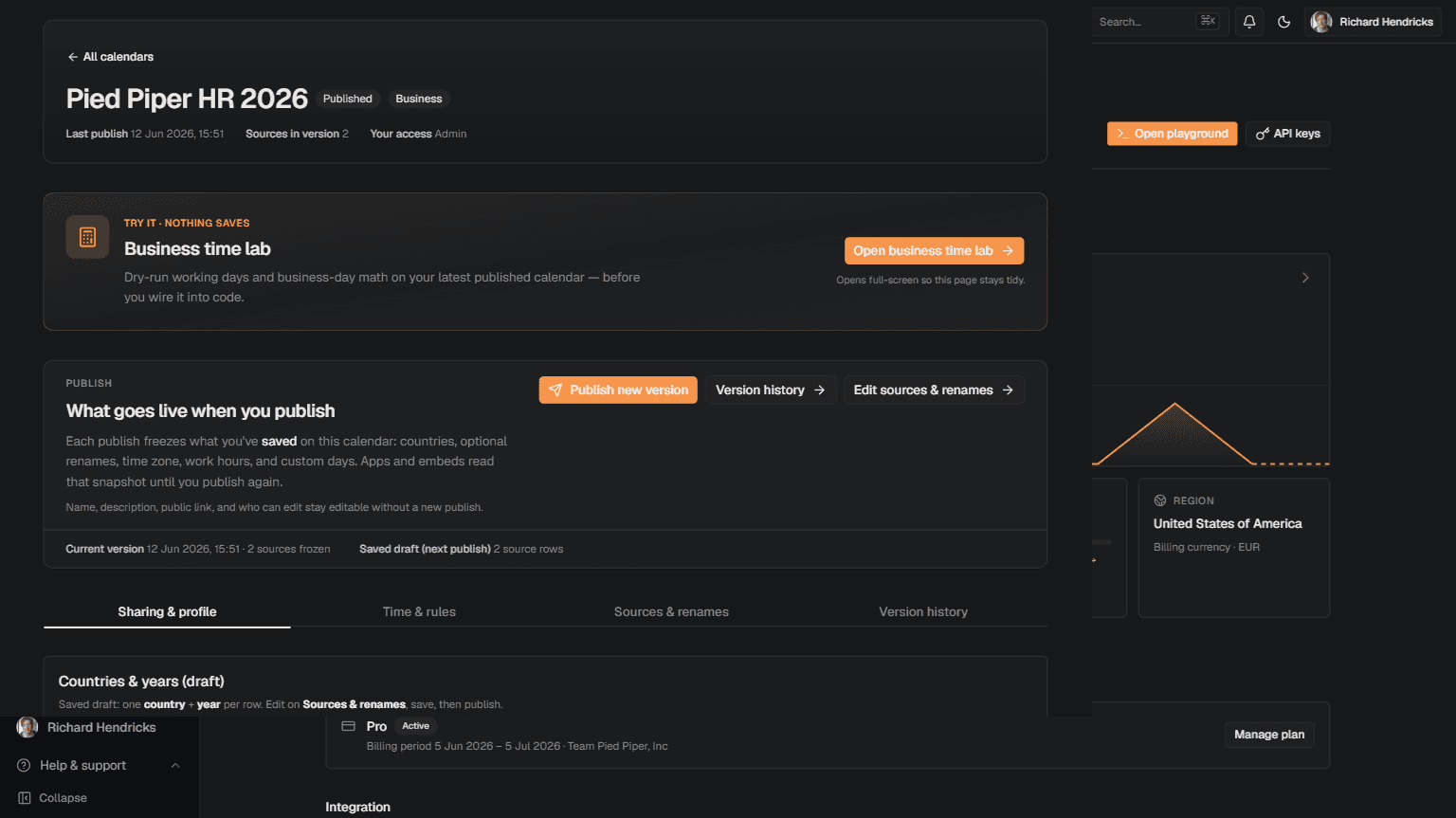
Holiday calendars you can govern
Festivo is no longer “only JSON in Postman.” Teams can own named calendars that wrap authority data with your rules, versions, and publishing discipline.
- Compose calendars from countries, regions, and years; iterate in draft, then publish an immutable snapshot your systems can pin to
- Version history and side-by-side compare so approvers see exactly what changed between releases
- Timezone and working-hours profiles per calendar so downstream consumers see holidays the way your business operates
- Blackouts and working-day exceptions layered on top of official data — not a bolt-on spreadsheet
- Organization-scoped access and membership so PMs, ops, and engineers collaborate without sharing production API keys casually
HiBob-first HR sync on governed calendars
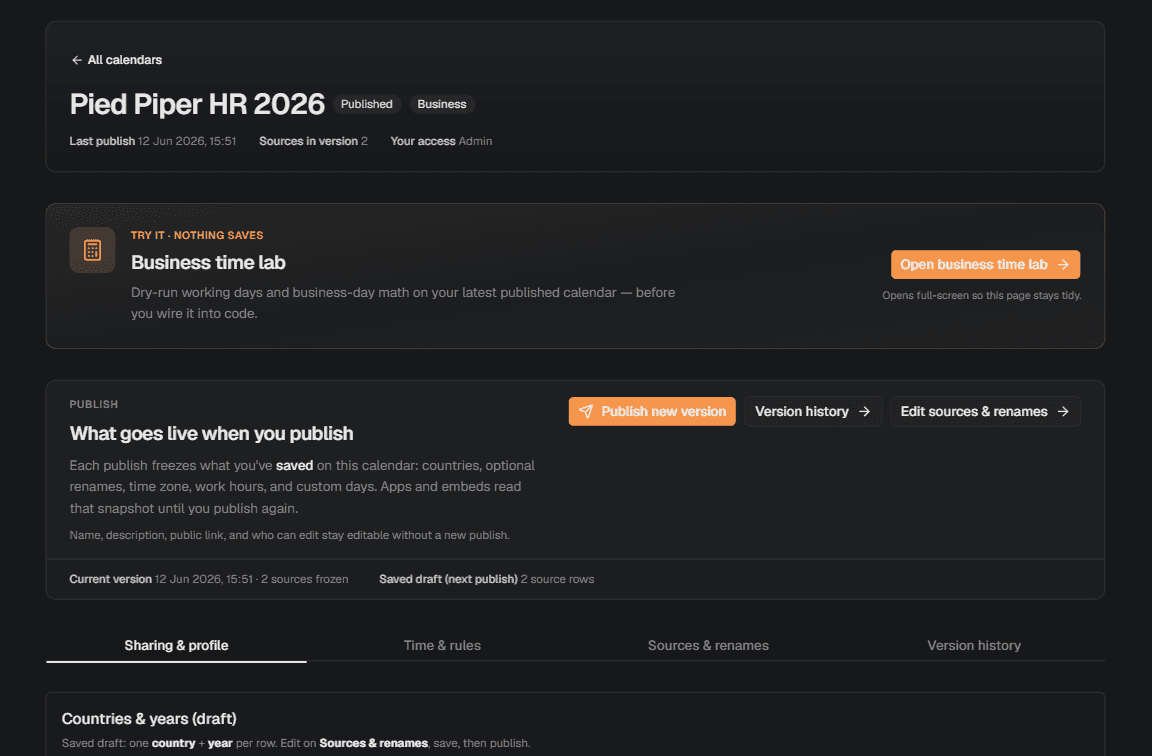
Growth-and-above teams can connect HiBob with a service-user model so Festivo reads company calendars and time-off signals, then maps that reality onto draft calendars, publish, widgets, and ICS — fewer spreadsheets between HR and engineering.
- Encrypted team credentials, verify-from-settings, and audit-oriented snapshots so infosec can review what we call and when
- Optional scheduled refresh with deliberate throttling so large tenants stay within HiBob rate guidance without babysitting jobs
- Apply HR snapshots toward Festivo calendars (including publish) so published truth matches what HR runs day to day
- Time-off request proxy where HiBob’s API allows writes, keeping booking paths in one controlled surface
- Other HRIS and calendar providers stay on the public integrations roadmap; HiBob ships first because the API surface is reviewable end to end
Business time & SLAs on real calendars
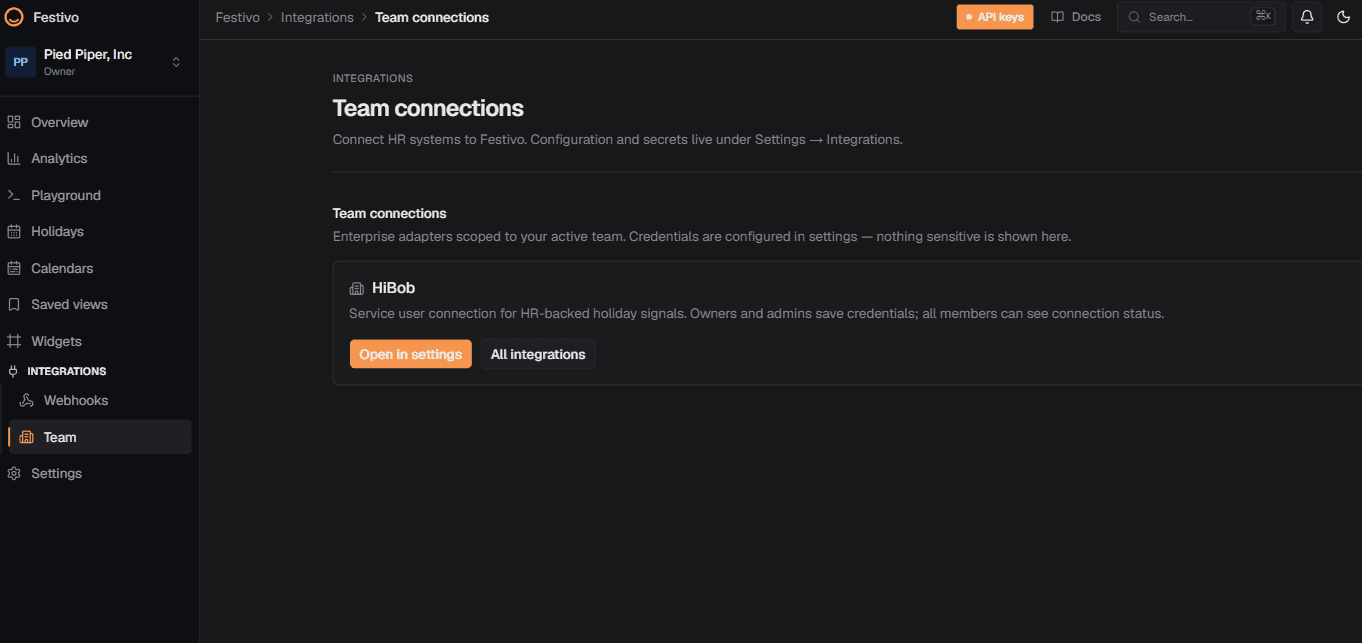
Scheduling logic needs more than “is it a weekend.” We shipped calendar-backed business primitives and a lab to validate behaviour before you wire code.
- REST helpers: check a date, add / subtract business days, next working day, inclusive business-day count — entitlement-aware
- Working-hours overlap probes for SLA-style questions across windows and calendars
- Business Time Lab (authenticated, per calendar) to interactively probe the same engine your integrations call
Public web, embeds, and ICS — ship holiday truth visibly
Many teams need human-visible holiday truth on the marketing site, wiki, or customer portal — not only backend JSON.
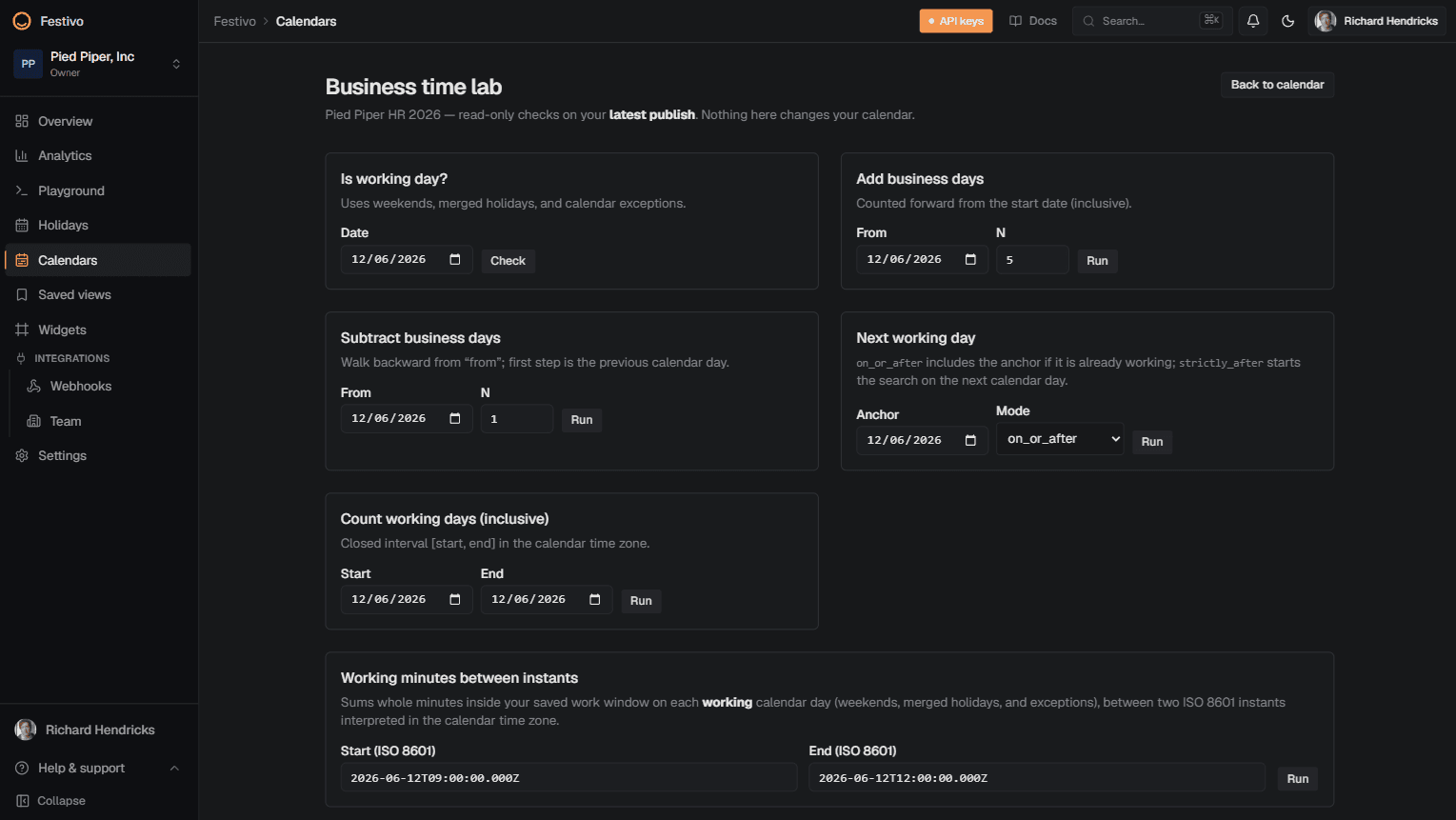
- First-party public pages for published calendars: month, week, and agenda views with stable, shareable URLs
- Org-branded public paths when you configure a public slug — same engine, your namespace in the URL

- Hosted widget loader on the Festivo portal host plus scoped publish tokens and origin controls where your plan supports embeds
- ICS exports for published calendars from workspace and embed-oriented flows so calendars land in Outlook, Google Calendar, or automation tools
- A dedicated Widgets (embeds) area to rotate tokens, preview snippets, and manage allowlists without spelunking through unrelated settings
A rebuilt customer portal — not a reskin

This is a cross-cutting release: navigation, layout, responsive behaviour, and dark mode were revisited across dashboard, playground, holidays, analytics, calendars, embeds, saved views, integrations, billing, onboarding, and support.
- Notification centre (bell) that pulls together subscription health, onboarding gaps, seat usage, daily quota, and API reachability — actionable, not decorative
- Banners for quota, trial, past due, cancel scheduled, and on-hold states so account risk is obvious before it surprises production
- Guided onboarding and lifecycle screens (upgrade, downgrade, on-hold) so teams don’t get stuck between billing state and product access
- Help hub and structured support intake so answers aren’t buried three clicks deep
- Footer What’s new with versioned in-app notes so returning users can skim ship cadence without leaving the workspace
Developer workflows that respect how teams ship
The portal is the spec surface as much as the billing UI: exploration, export, and automation hooks are first-class.
- Playground with persisted requests and OpenAPI / Postman export so the exact call shape travels with your ticket
- Holidays explorer with watchlists, compare mode, and read-only share links so PM + engineering agree before code lands
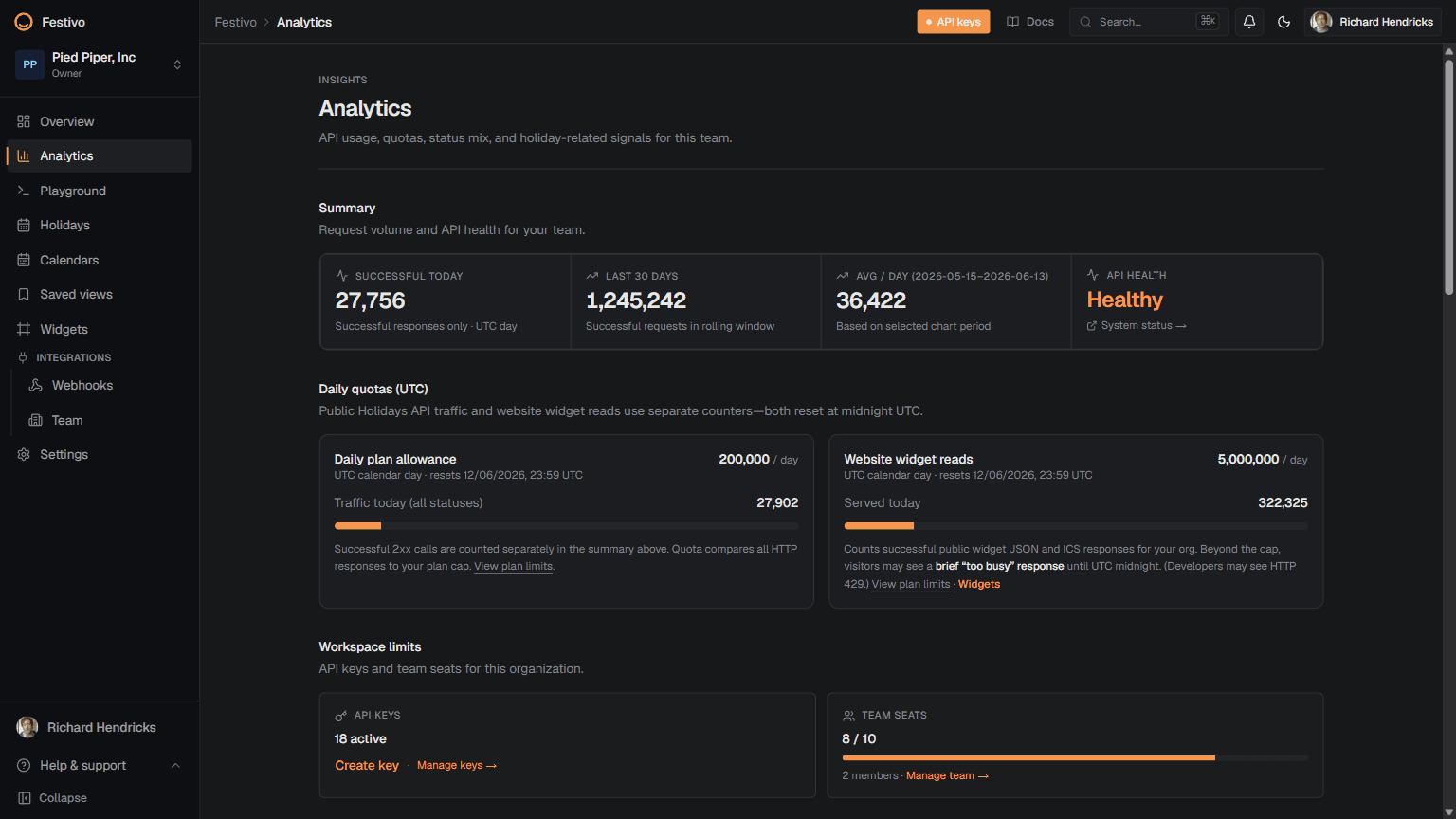
- Analytics fed by the same usage statistics that power the bell and banners — fewer “why is quota wrong?” mysteries after a long explorer session
- User webhooks with signed payloads and test delivery from the UI — connect Slack, Teams, or other tools without standing up a proxy first
- Integrations home surfacing first-party connections instead of scattering them across settings
- API tokens with rename, last-used ordering, onboarding deep links, and tighter security affordances for rotation hygiene
Account, team, and commercial depth
B2B SaaS isn’t only features — it’s who can do what, how you pay, and how operators help you when something breaks.
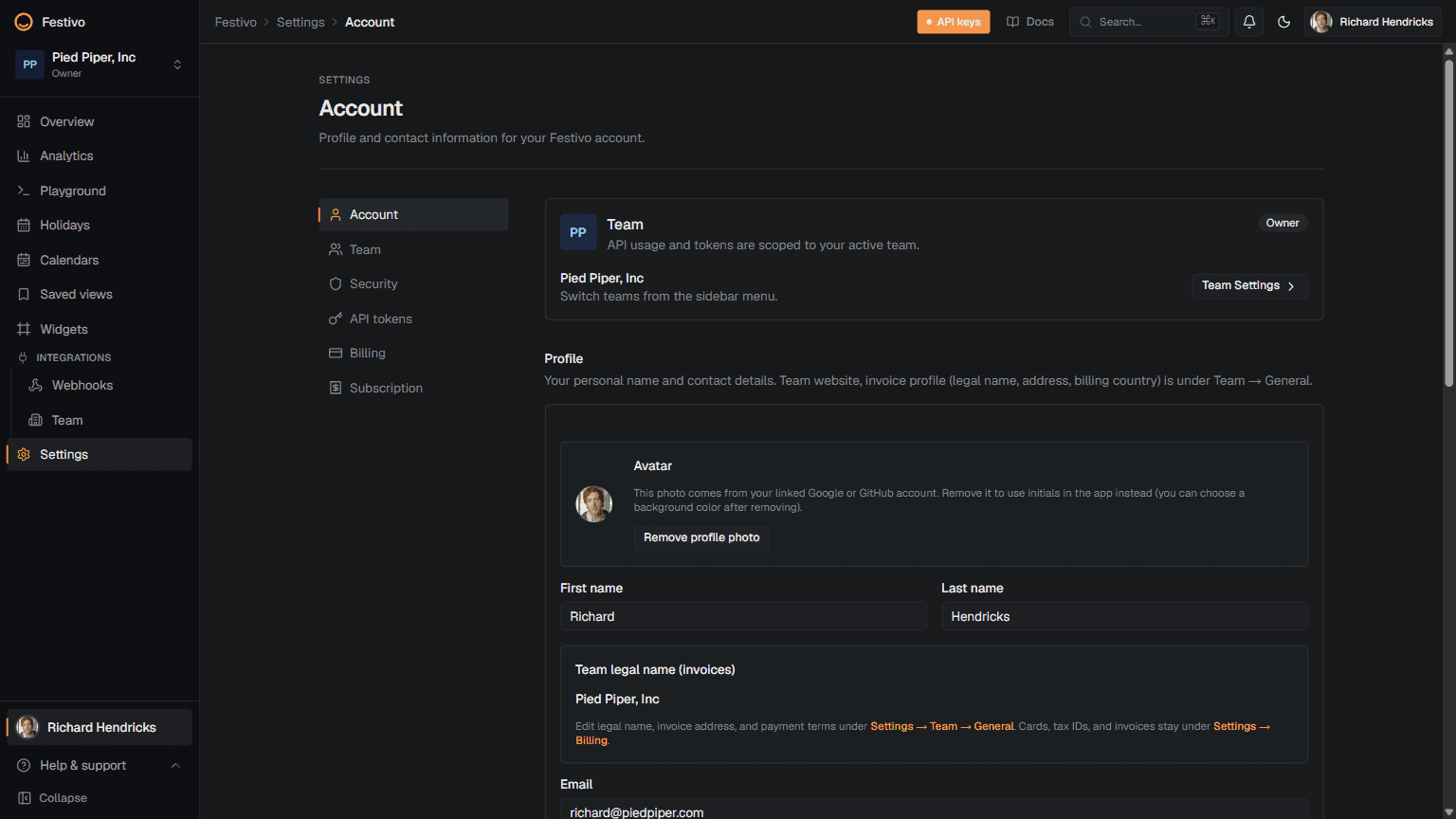
- Email sign-in, Google, GitHub, and passkey sign-in hardened for fewer dead ends; real names on join to keep tenant quality high
- Team invites, roles, organization switching, and activity views where your plan enables them
- Enterprise OIDC and SAML administration surfaces for owners and admins provisioning through your IdP
- Privacy & communications: explicit toggles for marketing vs product-announcement mail, with operational mail (sign-in, billing, security) clearly separate
- Self-serve billing: payment methods, EU tax identifiers, invoices, purchase orders, and subscription management surfaced consistently
- Festivo admin console (for us): cross-tenant tools for teams, subscriptions, usage, invoices, and support — so we can stand behind the SLA you expect
Go deeper
Changelog, docs, and resources — same story, more pixels of detail.